SDX ZynoraCode Compliance And Permit Approval

Any Jurisdiction. Any Building Code. One Intelligent Compliance Platform.

SDX Zynora uses artificial intelligence (AI) to read building codes and regulations into machine-readable checks and validates your Industry Foundation Classes (IFC) models against them automatically. Reviewers confirm results, track every comment and record each permit decision, all in the browser.

  • Codes from any jurisdiction, read by AI and approved by your experts
  • Every IFC submission validated: clause, measured value, Pass, Review or Fail
  • Comments followed to closure and a decision recorded for every round
01Smarter Designs.

Designers see each code result while the design can still change.

02Seamless Compliance.

AI reads codes and regulations into checks that run on the IFC model automatically, for every version.

03Faster Permits.

Reviewers confirm results instead of measuring again, so each round is shorter than the last.

The SDX Zynora Workspace

Every Check, Comment And Round, On One Screen.

Every code check, comment and permit round of a submission on one screen: what passes, what needs a reviewer, and how long until the decision.

Compliance ReviewHarbour Tower · Version 4Jurisdiction · Singapore
Checks Passed92.3%↗ 6.1% vs Round 1
Comments Closed64%↗ 12% this week
Review Round6.5days↘ 38% vs manual
Permit · Round 2 Of 3Decision In 9 Days
Today12 Nov
Submitted3 Nov 2026Decision Due21 Nov 2026
Pass Rate By Code SectionRound 2
92.3%↗ 6.1%
Zoning100Zoning
Height100Height
Fire861 fail · exit stair widthFire
Access78Level 5: no accessible toiletAccess
Parking100Parking
Energy92Energy
Structure95Structure
Compliance Score
92.3%248 Checks
Pass229
Review13
Fail6
Why SDX Zynora

Four Advantages Over The Tools Teams Use Today.

01

Codes Read By AI, Not Programmed By Hand

Typical ToolsRule-based checkers need specialists to program every clause, so each new jurisdiction means programming its code again.

SDX ZynoraArtificial intelligence reads the jurisdiction's own documents into machine-readable checks, and its experts approve them before they run.

02

Measured On The Model, Not On Drawings

Typical ToolsReviewers measure setbacks, heights and widths on drawings and PDFs, again in every round.

SDX ZynoraEvery check runs on the Industry Foundation Classes (IFC) model and links its result to the elements it measured, with clause, value and verdict.

03

One Record For Every Round

Typical ToolsComments sit in emails and marked-up PDFs, and decisions live in inboxes.

SDX ZynoraComments, versions and decisions stay in one project, with who, when and why for every round.

04

Every Party In The Browser

Typical ToolsApplicants and outside reviewers need the authoring software or a separate viewer to open the model.

SDX ZynoraReviewers, applicants and consultants join by invitation and open the model in any browser, each with their own role.

A white stepped civic building against a pale blue sky
The Review

Why Reviews Take So Many Rounds.

A design submission reaches the reviewer as drawings, models and emails. Measurements are taken again by hand, comments end up in one place and decisions in another, and later nobody can say which version was approved. SDX Zynora keeps the model, the code checks, the comments and the decision in one project, with a history of who decided what, when and why.

Authority ReviewersCheck a submission against the code in 3D, on plans and in Walk Mode, and record the decision for each round.
Clients And DevelopersFollow the review as it happens, see what is holding it up and exactly which version was approved.
Architects And ConsultantsReceive every comment with its element and clause, answer it and resubmit knowing what is still open.
Permit And Project ManagersDecide who reviews and who approves, see every open submission and keep the whole record in one place.
The Problem

What Gets In The Way Today.

Comments Scatter

Remarks arrive in emails, marked-up PDFs and meetings. There is no single list of what was raised, who owns it and whether it is closed.

Every Round Starts Again

Reviewers measure the same setbacks and heights again by hand, and every resubmission means reading the whole design again to find what changed.

Decisions Leave No Trail

An approval that lives in an inbox is hard to show later. Who approved, on what basis and in which round is rarely recorded in one place.

How SDX Zynora Works

From Submission To A Recorded Decision.

1

Submit

The design team uploads the IFC model as a new version of the submission.

2

Validate

The jurisdiction's code checks run on the IFC model automatically: setbacks, heights, areas, exits, parking.

3

Review

Reviewers confirm each result and raise comments in 3D, on plans and in Walk Mode.

4

Decide

The round ends with a decision: approve, approve with comments, or return, with the reason.

5

Resubmit

The revised model is compared with the last; only what changed needs a new look.

Inside SDX Zynora

What It Does, In Detail.

Code Intelligence

Automated Compliance Validation, Before Anyone Measures.

AI reads the jurisdiction's codes into machine-readable checks that its own experts review, set and edit: setbacks, building height, plot ratio, exit stair widths, accessible facilities, parking ratios. Every IFC submission is validated against them automatically, and each result shows the clause, the measured value and Pass, Review or Fail. The reviewer confirms a result instead of measuring it again.

  • Checks and thresholds your authority edits, never fixed in software
  • Clause, measured value and verdict on every result
  • Each result links to the elements it measured
  • Reviewers confirm or overrule, with a reason
Code Check · Submission 2026-118 · Round 2
14 code checks12 pass1 review1 fail
Front SetbackZoning 4.26.0 m ≥ 5.0 mPass
Building HeightZoning 4.526.4 m ≤ 28.0 mPass
Plot RatioZoning 3.12.8 ≤ 3.0Pass
Exit Stair WidthFire 7.31.05 m < 1.20 mFail
Accessible ToiletsAccess 2.41 per floor, Level 5 noneReview
Parking RatioPlanning 9.1142 for 140 requiredPass
Comments And Decisions

Every Comment Tracked. Every Decision Recorded.

Each comment is stored as an issue. It has an owner, a priority and a status, and it points at the element it concerns. When a round ends, the approver records the decision and the reason, so the history of the design can be shown at any later date, round by round.

  • Open, assigned, in progress and closed, per comment
  • Approve, approve with comments, or return for revision
  • Who, when and why kept with every decision
  • Comments travel to designers as BCF with their viewpoint
Review Rounds · Decision Record
  1. Round 1Returned For Revision12 comments: egress, setbacks, parking layout.Planning Officer · 3 Oct
  2. Round 2Approved With Comments3 comments to close before construction.Planning Officer · 24 Oct
  3. Round 3ApprovedAll comments closed. Decision recorded with its reason.Chief Reviewer · 7 Nov
Resubmissions

Review Only What Changed.

A revised model is imported as a new version and compared with the one before. Reviewers see which comments were resolved, which code results changed and what is new, so a second round is shorter than the first. Earlier versions stay available, and every decision stays attached to the version it was made on.

  • Version-to-version comparison of code results and comments
  • Earlier rounds stay available for audit
  • The model files submitted are never edited
Resubmission · Version 3 Against Version 2
New4
Resolved17
Unchanged3
ResolvedExit stair widened to 1.25 mFire 7.3
ResolvedFront setback moved back to 6.0 mZoning 4.2
NewPlant room now 0.6 m over the height limitZoning 4.5
Review In The Browser

Every Reviewer Sees The Same Building, With Nothing To Install.

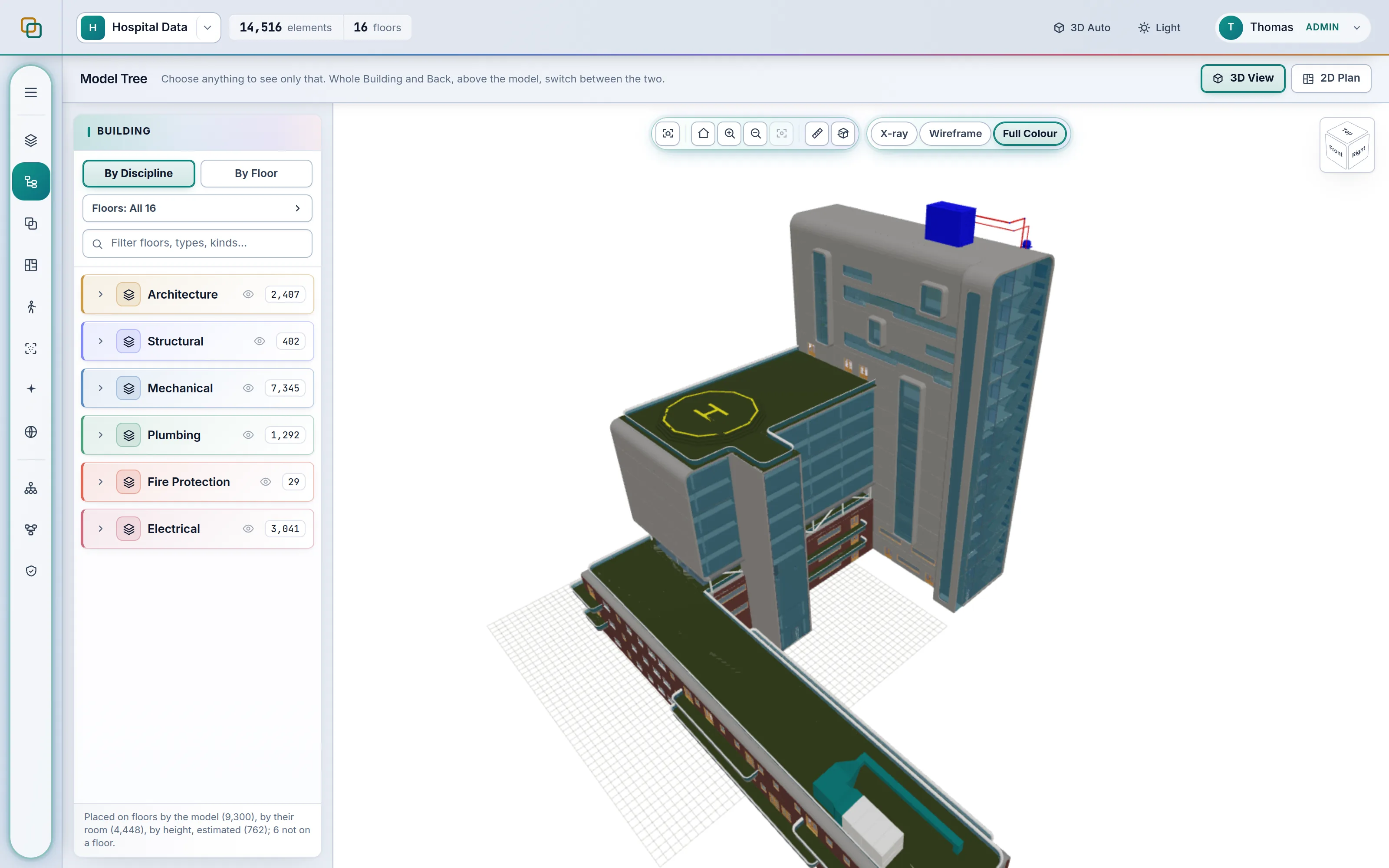
External reviewers join a submission by invitation and open it in the browser on any computer. They browse the model by floor and discipline, read real floor plans cut from the model with overall sizes, room areas and door widths, and walk the corridors at eye level. Roles decide who may comment and who may approve.

  • 3D model, dimensioned 2D plans and Walk Mode
  • Choose any element to see its properties
  • Invitation links, no software, no special computer
  • Roles for reviewers, approvers and applicants
SpaceDesignX · 3D Model
SpaceDesignX 3D Model screen
Business Benefits

What SDX Zynora Does For The Business.

What changes for the organisation, beyond the hours saved, when SDX Zynora runs on every project.

A white steel lattice canopy curving over the glass entrance of a civic building
Every RoundOne Record Of Every DecisionWho decided, when and why, kept with the model version

Risk Mitigation

Compliance gaps are found in the design, not at inspection, and every decision can be shown and defended later.

Ecosystem Leverage

Applicants submit IFC from whatever tool they use and comments return as BCF. Nobody changes software to take part.

Faster Time To Permit

Reviewers confirm results instead of measuring again, and a resubmission is reviewed only where it changed.

Scales Across Jurisdictions

New codes are onboarded from their own documents, so one platform serves many authorities and markets.

Regulatory Intelligence

AI That Reads The Building Code And Checks The Model Against It.

Our advanced data preprocessing pipelines and machine learning algorithms simplify the integration of building codes, regulatory frameworks and compliance requirements across diverse jurisdictions.

01Regulatory Documents

Building codes, zoning by-laws, fire and accessibility standards, from any jurisdiction.

Building CodeZoningFire SafetyAccessibility
02Preprocessing And Machine Learning

Clauses are read, structured and cross-referenced by our data pipelines and models.

03Machine-Readable Code

AI turns each requirement into a structured check your experts can read, edit and approve.

front_setback ≥ 5.0 mexit_stair_width ≥ 1.20 mparking ≥ 1 / 120 m²
04Validation On The IFC Model

Every check runs against the open-standard model, element by element, on every version.

Pass 229Review 13Fail 6
ForArchitectsEngineersDevelopersAuthoritiesAny jurisdiction · Any building code · Open IFC
Built For Every Jurisdiction

Designed For Adaptability And Global Scalability.

By transforming complex regulatory documents into structured, machine-readable compliance rules, SDX Zynora enables faster jurisdiction onboarding, scalable regulatory intelligence and automated compliance validation against open-standard IFC building models.

The technology minimizes manual configuration, accelerates regulatory adoption, and empowers architects, engineers, developers and authorities to navigate evolving building regulations with greater speed, accuracy and confidence.

  • Faster jurisdiction onboarding, from the jurisdiction's own documents
  • Scalable regulatory intelligence: one platform, many jurisdictions
  • Automated compliance validation on every IFC version
Jurisdiction Onboarding · Example
4 stagesFaster onboardingminimal manual configuration
  1. 1Documents ReceivedCode, by-laws and standards412 clauses
  2. 2Checks StructuredMachine-readable, cross-referenced388 checks
  3. 3Reviewed By Your ExpertsThresholds confirmed or edited371 approved
  4. 4Live On SubmissionsChecked on every IFC modelReady
SDX Zynora

Any Jurisdiction. Any Building Code. One Intelligent Compliance Platform.

Questions

SDX Zynora, Explained.

What Is SDX Zynora?

SDX Zynora is an intelligent compliance platform for building permits: it uses AI to read building codes and regulations from any jurisdiction into machine-readable checks and validates open-standard IFC models against them automatically. Reviewers open the submission in 3D and on 2D plans in the browser, confirm each result, raise comments as tracked issues and record a decision for every review round.

Which Jurisdictions And Building Codes Does SDX Zynora Support?

Any jurisdiction and any building code. Our data preprocessing pipelines and machine learning models turn regulatory documents, such as building codes, zoning by-laws, fire and accessibility standards, into structured, machine-readable checks. A new jurisdiction is onboarded from its own documents with minimal manual configuration, and its experts review and approve the checks before they run.

How Does Automated Compliance Validation On IFC Models Work?

Each machine-readable check runs against the elements of the submitted IFC model: distances, heights, areas, widths, counts and the relations between spaces. Every result shows the clause, the measured value and Pass, Review or Fail, and links to the elements it measured. Reviewers confirm or overrule a result with a reason, so people keep the decision.

Does The AI Make The Permit Decision?

No. Artificial intelligence reads the building code into machine-readable checks and the engine measures the IFC model against them, but people decide. The jurisdiction's experts approve every check before it runs, reviewers confirm or overrule each result with a reason, and an approver records the decision for the round, with who, when and why.

How Is SDX Zynora Different From Traditional Plan Review?

Traditional review reads drawings and PDFs and measures setbacks, heights and widths again by hand in every round. SDX Zynora measures the Industry Foundation Classes (IFC) model itself against machine-readable checks, links every result to the elements it measured, keeps comments and decisions in one record, and opens in the browser for every party, so a second round only looks at what changed.

Can Design Teams Run The Code Checks Before They Submit?

Yes. The same machine-readable checks the reviewer uses can run on the design team's own model while the design can still change, so a missing accessible toilet or a narrow exit stair is fixed before submission instead of being returned in a review round.

Can SDX Zynora Check A Design Against The Building Code?

Yes. The requirements an authority applies, such as setbacks, building height, plot ratio, exit widths and parking ratios, are kept as checks that the authority's own experts set and edit. Every submission is measured against them, and each result shows the clause, the measured value and Pass, Review or Fail, so the reviewer confirms a result instead of measuring it again.

How Does A Design Submission Get Reviewed And Approved?

The design team uploads the model as a new version of the project. Reviewers are invited, examine it in 3D, on dimensioned plans and in Walk Mode, and raise issues with an owner, a priority and a status. When the round is complete, an approver records the decision and the reason. A resubmission is compared with the previous version.

Can Authority Reviewers And External Consultants Take Part Without Installing Software?

Yes. Everything runs in a web browser. An administrator invites each reviewer with a one-time link, and the person's role decides what they may see and do. External reviewers see only the projects of their own organisation.

How Are Review Comments Tracked And Sent Back To The Designers?

Each comment is an issue with an owner, a priority and a status (open, assigned, in progress or closed), tied to the element it is about. Issues are exported as BCF, the open issue format, so designers see each one with its viewpoint in their own modelling tools.

Is Every Review Decision Recorded?

Yes. Each decision keeps who made it, when, and the reason, for every review round, so the approval history of a design can be shown at any later date.

How Are Resubmissions Compared With The Previous Round?

The revised model is imported as a new version and compared with the one before it. SpaceDesignX shows what is new, what was resolved and what is unchanged, so reviewers spend their time on what changed instead of reading the whole design again.

All Questions

Smarter Designs. Seamless Compliance. Faster Permits.

Show us how your authority or client reviews designs today. We will set up SDX Zynora around your jurisdiction's own codes and run a past submission through it.